
.webp)
Barind Medical College & Hospital is one of the most prestigious private medical institutions in northern Bangladesh. Founded in 2011 in Rajshahi — the educational hub of the country — BMC educates 602 medical students, including 175 foreign students from India, Nepal, and other countries, supported by a faculty of 145, including 20 professors, 14 associate professors, and a teaching team across more than 25 clinical and pre-clinical departments.
Beyond education, BMC operates a full-service hospital with emergency, outpatient, inpatient, diagnostic, operating theater, and ambulance services—serving thousands of patients across the Rajshahi region every month. With this scale comes a scale-of-communication challenge that the institution had to solve thoughtfully.
By 2022, BMC's administration was managing three communication workflows that had outgrown manual processes.
With students attending lectures, clinical postings, and ward rounds across multiple departments daily, keeping parents and guardians informed of attendance — particularly for foreign students whose families live abroad — was becoming impractical through phone calls or notice boards.
BMC operates a structured, growing mentor–mentee program—documented in a peer-reviewed paper published in the Barind Medical College Journal—that pairs medical students with experienced faculty mentors for academic guidance and pastoral care. Coordinating session reminders, class schedule updates, and follow-up messages between mentors, mentees, and supervisors required a reliable, scalable channel.
Appointment reminders, OPD schedules, diagnostic report-ready notifications, and emergency contact updates are needed to reach patients across the Rajshahi division — many of whom prefer SMS over app-based communication and rely on basic mobile phones.
The institution needed a single SMS communication backbone that could handle all three use cases reliably, cost-effectively, and in Bangla — without depending on faculty or administrative staff typing messages one number at a time.
After evaluating options, BMC selected Swift SMS Sender for four specific reasons:
ASTGD, the parent company behind Swift SMS Sender, is also headquartered in Rajshahi. For an institution that values long-term partnerships, having the service provider in the same city — reachable in person when needed — was a meaningful trust factor.
Communication with Bangladeshi parents and patients works best in Bangla. Swift SMS Sender supports full Unicode Bangla messaging across all four telecom operators (Grameenphone, Robi, Banglalink, Teletalk).
BMC's attendance and mentorship workflows are managed in custom systems. Swift SMS Sender's REST API — with HTTP/HTTPS support and ready-made sample code — allowed ASTGD's development team to embed SMS triggers directly into BMC's existing software, including a dedicated BMC Mentorship Management Android app published on Google Play and built specifically for the program.
Communication with Bangladeshi parents and patients works best in Bangla. Swift SMS Sender supports full Unicode Bangla messaging across all four telecom operators (Grameenphone, Robi, Banglalink, Teletalk).
For an institution that buys in bulk and uses over months, knowing credits never expire and that pricing is flat with no hidden charges was non-negotiable.
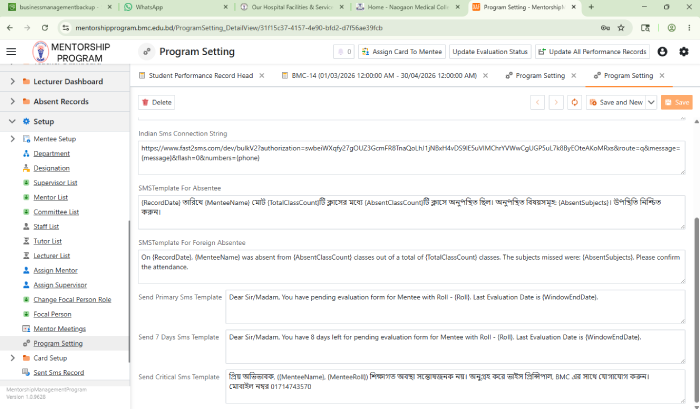
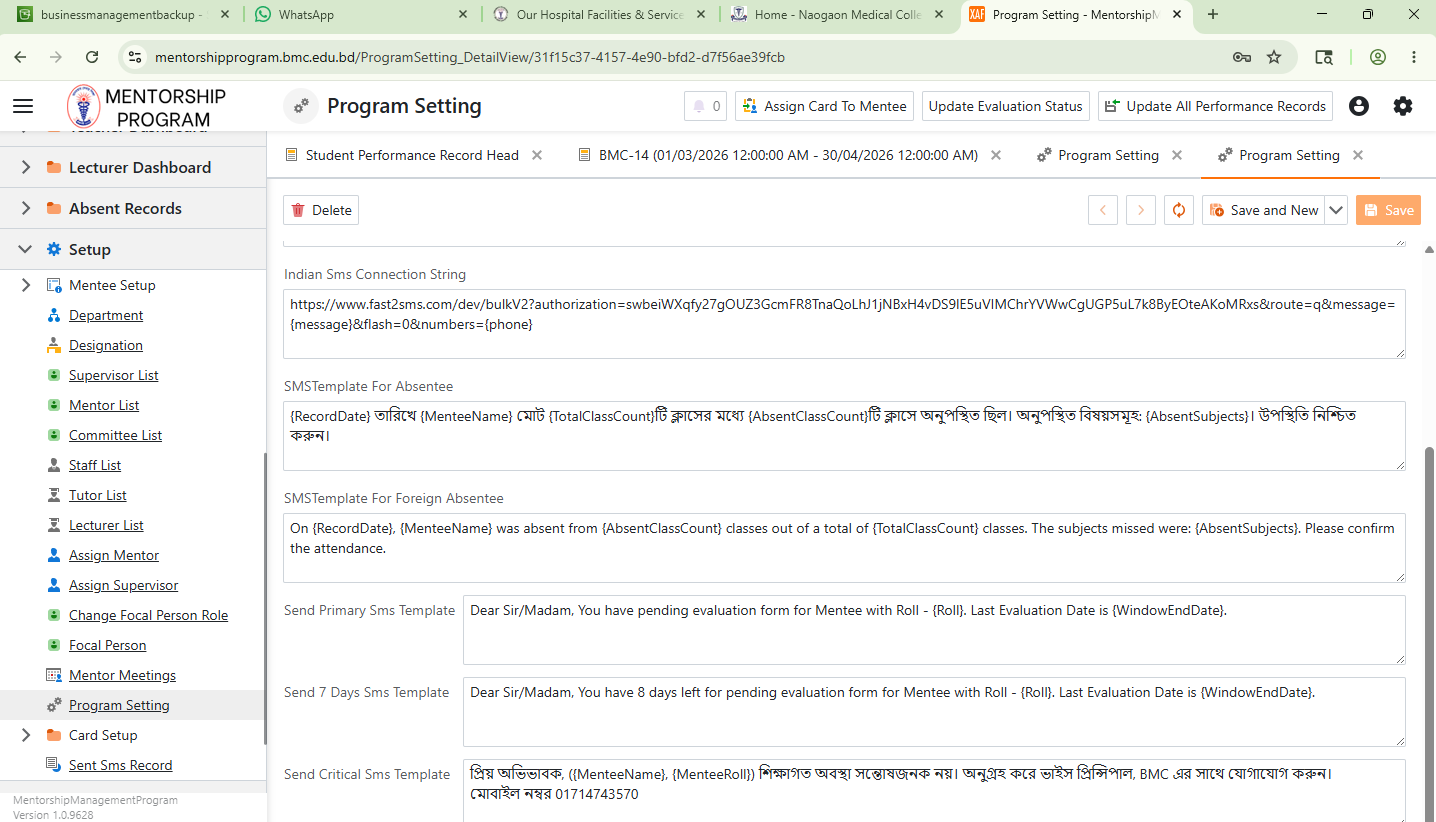
The college's attendance system, when a student's status is marked, automatically triggers an SMS to the parent or guardian's registered mobile number. Messages are sent in Bangla for local guardians and English for international families — all from a branded sender ID so the family instantly recognizes the message is from BMC. This eliminated phone-call follow-ups by administrative staff and gave parents same-day visibility into their child's academic engagement.
The BMC Mentorship Management system—accessible to faculty mentors, mentees, and supervisors—uses Swift SMS Sender's API to send session reminders, class record updates, evaluation notifications, and supervisor alerts. The published academic paper on the program highlights how structured mentorship needs "protected time, clear agreements, and continuous feedback"—SMS reminders are now the backbone of that continuous feedback loop, making sure mentors and mentees never miss a scheduled session.
The hospital uses the same SMS backbone for appointment reminders, OPD scheduling updates, diagnostic report-ready alerts, and emergency contact broadcasts. Patients receive messages with the hospital's branded sender ID, increasing trust and reducing missed appointments.
Over three years of continuous use, BMC reports measurable operational improvements across all three workflows.
Attendance-related parent inquiries dropped sharply, as guardians now receive direct daily visibility instead of needing to call the office. Mentor–mentee session attendance improved with automated reminders replacing manual follow-up. Patient appointment no-shows decreased thanks to timely SMS reminders, particularly for diagnostic and follow-up visits. Administrative staff time previously spent on phone-based notifications was redirected to higher-value tasks. Communication with international parents — especially in India and Nepal — became reliable and timely. The institution has continued using Swift SMS Sender Sender every academic year since 2022 across all three use cases without disruption.
“Swift SMS Sender has helped us improve communication efficiency across our academic and patient management activities. Their SMS platform is reliable, fast, and easy to use.”